
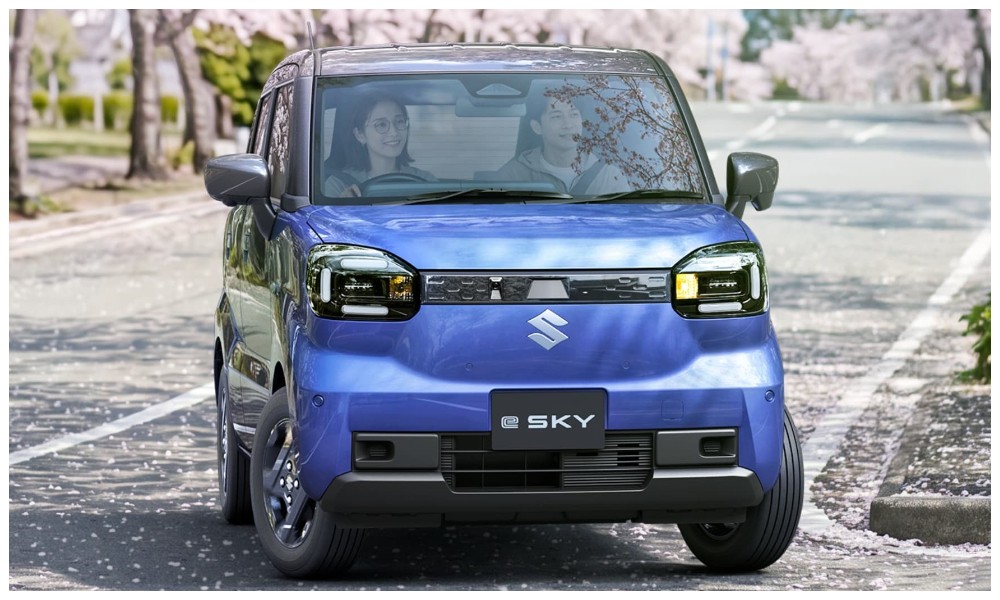

Suzuki has revealed the e-Sky, a compact electric Kei car developed for everyday urban mobility in Japan. The new EV combines a sub-3.4-metre footprint with a claimed 310km driving range, making it one of Suzuki’s most significant entries into Japan’s growing electric minivehicle segment.
Designed around the idea of making the switch from petrol to electric easier, the e-Sky focuses on low weight, efficiency and easy manoeuvrability rather than outright performance. Suzuki says the model is intended for commuting, school runs, shopping and other routine journeys.
The production-oriented e-Sky measures 3,395mm long, 1,475mm wide and 1,625mm tall, with a 2,460mm wheelbase. Its compact dimensions are tailored to Japan’s Kei-car category, while the tall body helps maximise usable cabin space.
Suzuki e-Sky: Key Highlights
• Claimed range of up to 310km
• Kerb weight of 1,030kg
• 3,395mm overall length
• 26kWh battery
• Two-wheel-drive electric powertrain
• 10.1-inch touchscreen
• Vehicle-to-Load (V2L) functionality
• Expected Japanese market launch in autumn 2026
Compact Dimensions With a Practical Cabin
The e-Sky’s biggest strength is its compact footprint. At 3,395mm long, it remains easy to manoeuvre on narrow streets and should be straightforward to park in tight urban spaces. The 2,460mm wheelbase is relatively long compared with the overall length, helping Suzuki free up additional room inside.
The tall-boy body is another important part of the package. Instead of stretching the car’s exterior dimensions, Suzuki uses its height and cabin layout to create a more practical passenger compartment.
Suzuki e-Sky Exterior Design
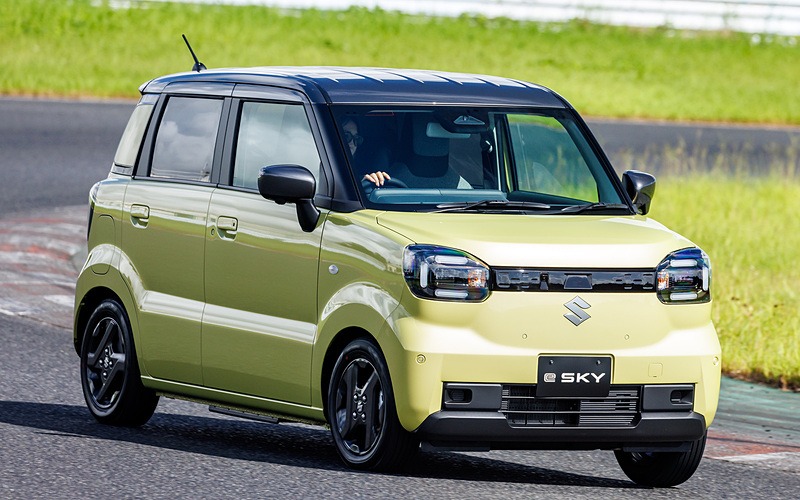
The e-Sky adopts a clean, upright design rather than the aggressive styling seen on many larger EVs. At the front are compact LED lamps linked visually by a dark connecting panel, while the absence of a conventional grille highlights its electric powertrain.
The side profile features blacked-out pillars, squared-off wheel arches and a simple character line along the doors. At the rear, vertically oriented lamps, a roof spoiler and a relatively flat tailgate reinforce the car’s practical city-car character.
Interior and Technology
Inside, Suzuki has focused on making the small cabin feel useful and uncluttered. The dashboard incorporates a broad, flat design, while the gear selector is positioned close to the steering wheel to free up space elsewhere in the cabin.
A 10.1-inch display serves as the central infotainment interface and is paired with a digital instrument display. The e-Sky also offers connected navigation, keyless functionality and Vehicle-to-Load capability, allowing the battery to power compatible external electrical equipment.
Suzuki has also developed the cabin around everyday EV usability. Features such as an efficient heating system and easy-driving functions are intended to make the transition from a petrol-powered Kei car less demanding for existing users.
26kWh Battery and 310km Range
One of the most notable aspects of the e-Sky is its efficiency. The model uses a 26kWh battery and has a reference driving range of 310km. Suzuki has achieved this figure through a combination of low vehicle weight and energy-efficiency improvements.
At 1,030kg, the e-Sky is relatively light for a modern four-door battery-electric car. The battery uses lithium-iron-phosphate (LFP) chemistry, while the electric drivetrain is designed around efficient packaging and low energy consumption.
The 310km figure should be treated as a claimed/reference range rather than a guaranteed real-world distance. Actual range will vary with driving conditions, temperature, traffic, payload and use of climate control.
Charging and EV Usability
Suzuki has also paid attention to charging convenience. Prototype information indicates support for both AC charging and DC fast charging. Final production specifications and charging times should be confirmed closer to the market launch.
The availability of V2L further expands the e-Sky’s usefulness beyond basic commuting. Owners can potentially use the vehicle as a portable power source for compatible equipment, making the feature useful during outdoor activities or emergencies.
Expected Launch
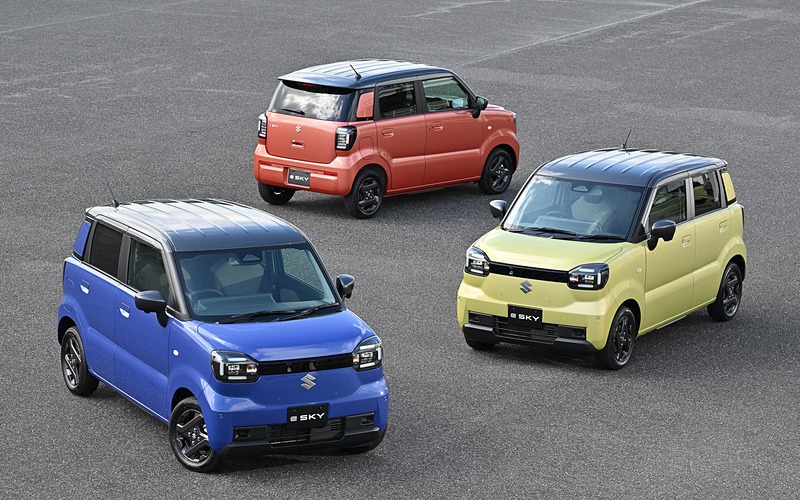
Suzuki says the e-Sky is scheduled to be introduced in Japan during autumn 2026, within the company’s current financial year ending in March 2027. Pricing has not yet been announced.
The company is positioning the e-Sky as an accessible EV designed to encourage existing petrol-car users to make the switch to electric mobility. Its small size, low weight and relatively long claimed range could therefore be central to its appeal.
Will Suzuki e-Sky come to India
Suzuki has not confirmed an India launch for the e-Sky. The car has been engineered around Japan’s Kei-car regulations, so bringing it to India would require consideration of local regulations, customer expectations and pricing.
However, the concept is relevant to India’s growing compact EV market. A small Suzuki electric car with a range of around 300km could potentially sit between ultra-compact city EVs and larger electric hatchbacks if it were adapted for the Indian market. For now, an India launch remains speculative and should not be treated as confirmed.
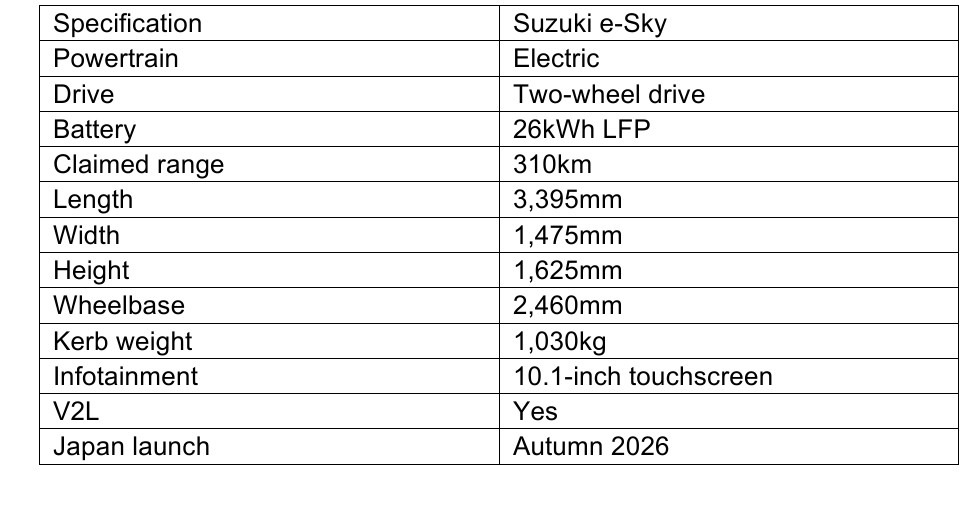
Suzuki e-Sky Specifications
Frequently Asked Questions
What is the Suzuki e-Sky?
The Suzuki e-Sky is the company’s first electric passenger Kei car, developed primarily for urban mobility in Japan.
What is the Suzuki e-Sky range?
Suzuki quotes a reference range of up to 310km. Real-world range will depend on conditions and driving style.
What battery does the e-Sky use?
The e-Sky uses a 26kWh LFP battery.
When will the Suzuki e-Sky launch?
Suzuki plans to introduce the e-Sky in Japan during autumn 2026, within the financial year ending March 2027.
Will the Suzuki e-Sky launch in India?
There is no confirmed India launch at present. Any Indian-market introduction would require official confirmation from Suzuki/Maruti Suzuki.